
Iridology
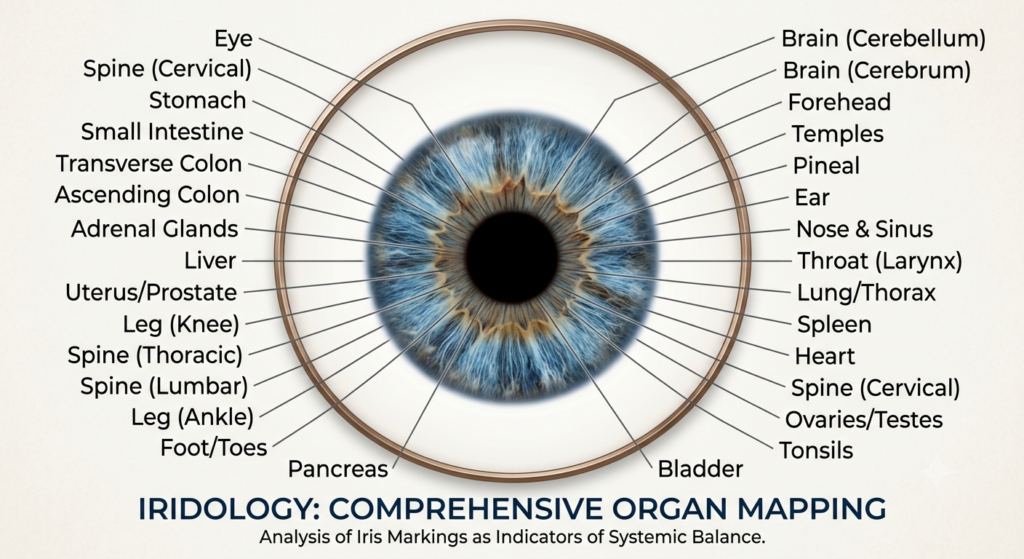
What is Iridology?
Iridology is a non-invasive, holistic assessment technique that analyzes the iris—the colored portion of the eye—to gain insight into an individual’s constitutional health, bodily stress, and tissue integrity.
According to iridology theory, the complex nerve fibers, patterns, colors, and structural markings within the eye act as a reflection of the central nervous system. By examining these unique features, practitioners evaluate systemic balance, inheritable genetic tendencies, and underlying physical vitality.
Why is it Used in Health Assessment?
In holistic and integrative practice, iridology is not used to label specific pathology or name medical diseases (like diabetes or cancer). Instead, it serves as a functional assessment tool to guide personalized wellness plans.
Key Reasons Practitioners Implement Iris Analysis
Identifying Constitutional Strengths & Weaknesses: Every individual inherits a distinct connective tissue structure. Iris patterns reveal inherent genetic predispositions, showing which organ systems may require proactive nutritional or lifestyle support.
Assessing Tissue Integrity & Toxicity: Variations in fiber density, pigmentation shifts, and structural markings highlight areas experiencing cellular stress, sluggish lymphatic flow, or inflammation.
Understanding Gut & Systemic Health: In traditional iridology charts, the central ring surrounding the pupil corresponds to the digestive tract. Practitioners use this zone to evaluate digestive efficiency, assimilation, and microbiome balance.
Tracking Functional Changes: Because nerve responses reflect physiological shifts over time, sequential iris observations help monitor how a patient’s body responds to dietary modifications, detox protocols, and supplementation.
Non-Invasive & Immediate: Iris examination causes zero discomfort, requires no blood draws, and provides immediate visual feedback during a consultation.
How It Works: The Iris Map
Iridology relies on a standardized map that divides the iris into distinct zones, functioning much like a clock face:
The Inner Zone (Pupillary Zone): Represents stomach, intestinal health, and nutrient absorption.
The Middle Zone (Ciliary Zone): Reflects major organs, including the heart, lungs, liver, kidneys, and endocrine glands.
The Outer Ring: Corresponds to the lymphatic system, circulation, skin, and elimination pathways.
By combining high-resolution iris photography with case history and lifestyle factors, practitioners gain a comprehensive view of the body’s overall resilience.
